
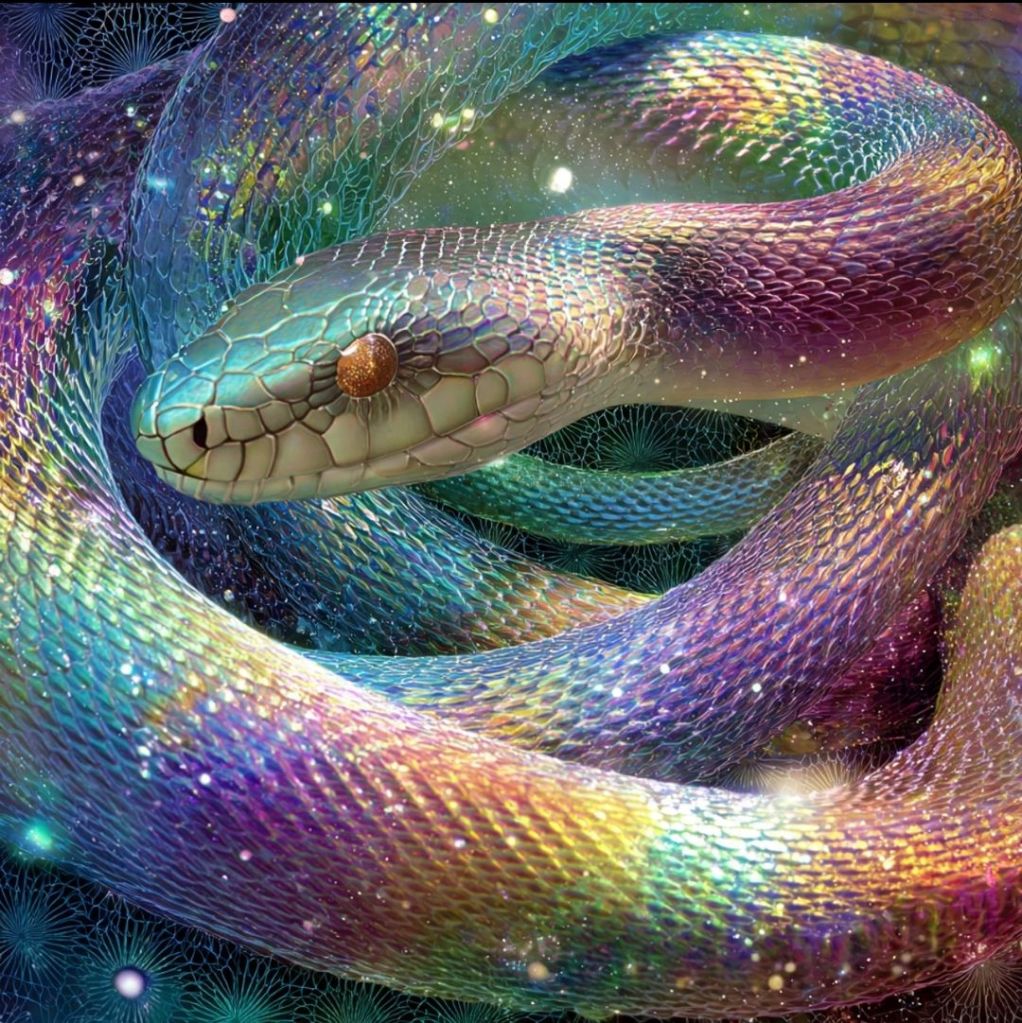
The serpent teaches us of balanced transformation through embodied awareness; our connection of the white light of electromagnetic polarity, to the black light of ætheric oneness. Here, we become embodied in the polarity of the material world, while perceiving the oneness of cosmopanpsychic consciousness. In this world, yet, not of this world, so-to-speak.
Embodiment is an umbrella term, where the spectrum of embodiment ranges from the physical data of our senses, to the mental and emotional processing of that data. Embodiment is our conscious, subjective experience of being a hue•man being; deeply integrating our mind, body and the perceived space around us.
Parasympathetic (rest and digest) dominance, specifically a well-regulated ventral vagal state with high heartrate variability and entropy, is essential for true embodiment. It signals physiological safety to our brain, allowing us to access our internal physical cues, process emotions and to stay grounded — without unnecessarily slipping into a fight, flight or freeze response.
Proprioception and interoception are embodiment’s physical aspects. Proprioception, is our body’s sensory system that gives our body the unconscious ability to perceive our own movement and spatial location, without having to use our eyesight. It relies solely on sensory receptors in our muscles, joints and tendons, to instantly map where our limbs are at all times.
Interoception, is our body’s sensory system that detects and interprets internal signals like hunger, thirst, heartbeat and our need to urinate or defecate. Interoception allows our brain to understand our physical condition, which directly influences our emotions and self-regulation.
Beyond this, is our embodied sensing of the more subtle frequencies of electromagnetism in and around us.
Our fascia, too, plays a critical role, in our embodiment, as an interface between our subtle bodies and our nervous system. It is our fascia and its liquid crystalline structure, that may hold trauma; that then sends signals of danger to our brain, thus affecting our nervous system regulation and pain modulation.
Both proprioception and interoception function automatically via nerves, receptors and our brain stem; even when we are completely distracted or asleep. Somatic awareness, on the other hand, is the mindfulness aspect of embodiment. It is the conscious focus we direct toward our physical systems of embodiment. It is the bridge between our mind and our body’s sensory data.
Ætheric Embodiment is the ultimate integration where we live, feel and make decisions — using our embodiment alongside our conscious awareness of the black light of ætheric oneness. Ætheric Embodiment is how our avatar experiences, interacts with and understands — our dualistic world. The ætheric within and the polaric without.
Through shadow-work, we surface our subconscious and unconscious mind, to our conscious awareness. And so, Ætheric Embodiment is shadow-work through form and movement. Broadly speaking, there are many powerful ways to cultivate embodiment, such as: fasting, conscious eating/assimilation, tantra, etc. Ætheric Embodiment, however, is focused on embodied awareness through form (Earth Element) and movement (Air Element). Ætheric Embodiment draws upon the practices of both Qigong and Yoga; yet, focuses upon principles, intuition and perception. Here, one uses the perception of their body’s sensations and unforced breath as a guide; as opposed to forcing rigid technique. Each body will express these principles and perceive these sensations, of texture, in its own unique ways. And so, technique and physiology are good to have knowledge of, yet every body will express the principles of Ætheric Embodiment differently.
Ætheric Embodiment also recognizes that Yoga and Qigong each have their own unique focuses and strengths. Yoga builds vitality by embracing tension through form (Earth Element), while Qigong builds vitality by releasing tension through movement (Air Element). In other words Yoga trains stability through structure, while Qigong trains resilience through flow. An obvious overlap between the two is most certainly our breath’s role in embodiment. Anapanasati is mindfulness of breath. Wu Wei breath is the effortless effort of breath flowing. Here, one must first be able to fully be with their breath before being able to effortlessly flow with their breath unbroken; only then may one escape the sense of meditating, to become the æther embodied.
Ultimately, both Yoga and Qigong are designed to yoke (Yoga means yoke in Sanskrit) body and mind, through the embodied awareness achieved through balanced transformation. Embodied in the white light of electromagnetism, while aware of the medium of black light– the ætheric oneness of cosmopanpsychic consciousness.
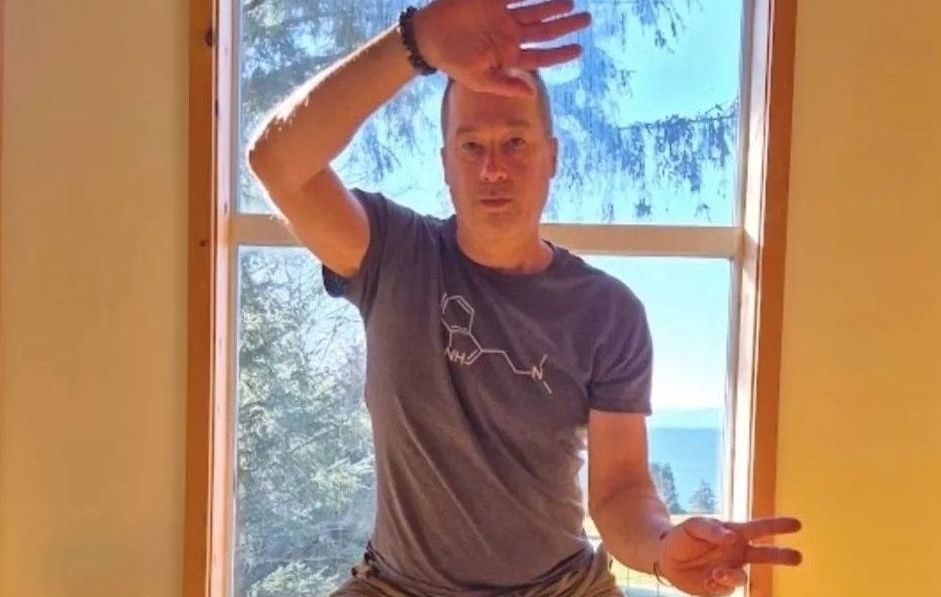
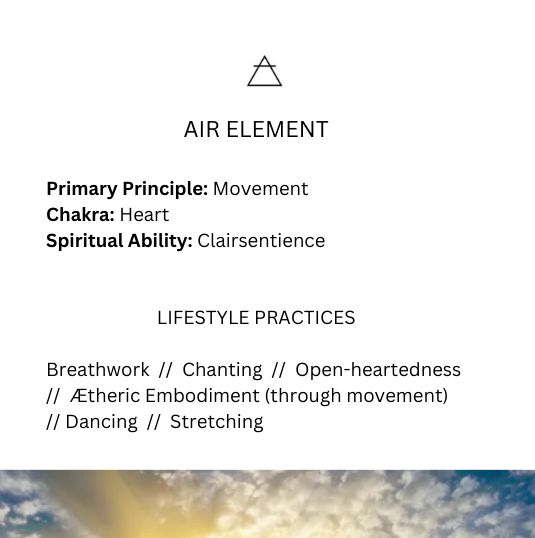
Ætheric Embodiment, through form and movement, are ætheric lifestyle practices that correspond to the Earth Element (Root Chakra) and the Air Element (Heart Chakra).

To learn more about the ætheric lifestyle practice of Ætheric Embodiment, join the community.
 The Ætheric Lifestyle